Pages

Follow Me on Twitter

Showing posts with label self-care. Show all posts

Tuesday, January 18, 2022

Success in AP2—It’s More Than Coping, but Coping is Also Great, Really. I Promise.

Happy New Year, Readers. It’s been so long since I posted to you, I think my chin hairs have turned into a beard. (Shhh, forget I said that; it’s supposed to remain only between me and my esthetician.)

In this new year, Annus Pandemicus 2 (AP2), I offer a couple of tips for success. They’re not mine, originally, Readers, but I’ve incorporated them into my life after so many years of seeking and redefining success that they seem to be mine. In other words, I am probably plagiarizing, but I can’t remember from whose work. Along the way, I have encountered many teachers, gurus, and charlatans offering their worked-over or reworked bits of universally available wisdom. Home truths, if you will. They have managed to publish and profit from these things, unlike me, but hey, this isn’t a post about bitterness. It’s a post about the opposite of bitterness, which is, of course, sweetness. 

What makes life sweet? Have you seen the four seasons of “The Good Place” on Netflix? I recommend. Friends, family, self-confidence, generosity, striving to be better, and believing it is possible to be so. These are some of the things that make life sweet. More on that another day, mayhap. Or, if you stop reading here, then maybe you’ve got a little something, a nugget, a kernel to hold onto and work over, something to try to unwedge from your teeth.

I have really enjoyed my break from school. I have to say, it was an absolute pleasure to be done with required reading until the middle of January. During the break, I happened upon a book called The Five Invitations by Frank Ostaseki, a Zen Buddhist who started the Zen Hospice Project in San Francisco in the late 1980s. The Zen Hospice grew out of the San Francisco Zen Center, which, Readers, I visited back in the late 1980s, when I lived in SF. So I almost know Frank. Maybe if I’d actually attended regular meditations at the SF Zen Center, I would literally know Frank. Unfortunately, at the time, I was intimidated by the austerity of the setting and by the little I knew about Zen, so it was another ten years before I got around to meditating. 

What attracted me to the book is that back in 2020, when the paterfamilias was still alive but was starting to fail, my friend loaned me a large bag of books about death and dying that she and her mother had read when her mother was dying. I didn’t read any of the books she loaned me, because the paterfamilias failing was something I didn’t really want to grok, if you know what I mean. So the bag sat around for a long time. Eventually, during a culling of our over-full bookcases, I asked the husband to take all the books we were donating to the big donation bin at the library and he accidentally donated the entire bag of books on death and dying that my friend had loaned me. 

These books had significance for my friend, because her mother had been reading them in preparation for her own death, and now, in the way of books and people, her mother was gone and the books had remained. I felt terrible. So did the husband.

I’ll just fast-forward to say that my friend is still my friend. She took a philosophical stance about the lost books. She said, maybe now they’re being read by other people who really need to think about death and dying. 

Who doesn’t? I ask you. 

I have to add that I did my utmost to try to recover the books, but it was a no-go. So over the last couple of years, I have kept an eye out for books about death to give to my friend. 

This brings me to The Five Invitations, whose subtitle is “Discovering what death can teach us about living fully.” Since I’ve broadened my definition of success to include things like “well-being” and “living fully,” this seemed up the ole alley. And you know, a successful death is part of a successful life. 

What are the 5 invitations? In brief, they are as follows: 

One, Don’t wait; 

Two, welcome everything, push away nothing; 

Three, Bring your whole self to the experience; 

Four, Find a place of rest in the middle of things; and 

Five, Cultivate don’t know mind. 

These invitations are essentially the invitation of all meditation practices, the invitation to be present in your own life as it happens, without adding to your misery by trying to prevent or feeling shame about the bad times, and without expecting that life is meant to be always great. Agathism has to take a back seat to reality. Things don’t necessarily always get better. That’s just the way it be. On the other hand, in the midst of any particular moment in life, the possibility exists for feeling pretty okay. As Jon Kabat-Zinn said, any time you’re breathing, more things are going well for you than not. 

Did I say this was post about sweetness? Well, I want to talk about the idea of rest. Rest, the fourth invitation, is a kind of sweetness. The sweetness of letting go and just letting the shoulders settle, of shutting the door and enjoying a quiet moment at home. 

This idea of resting in the midst of upheaval seems particularly appealing, probably because I’ve been working myself hard in school, while grieving the paterfamilias and the end of civilization as we knew it. While some of my friends have announced a theme word for the year such as “improve” or “strive” or “persist,” I’m drawn to “rest.” Rest does not mean pulling the blanket over your head and waking up when the revolution is over, mind you. It means to find the center—your center—in the midst of upset, busyness, excitement, and goal-pursuit. Rest in the middle of striving, if you will. This is also known, less glamorously, as coping. And coping is really a great approach to life. Coping requires rest. 

So what is rest? There are different kinds of rest. 

There’s the rest from being awake, also known as sleep. That's physical rest. We are programmed to do this every day for about eight hours. For those of us who sometimes experience less than optimal nighttime sleep, the twenty-minute snoozle is a brilliant restorative in the middle of a day. Physical rest of the body. Obviously essential. 

There’s the rest that is residing in the moment. I hesitate to write about this, because it has become a cliché among certain types of people. But there is rest in focusing on the present. Sitting still, taking a breath, and being aware of your body breathing in and exhaling. There’s rest in that, and that kind of rest is super important. Why? Because it gives you a little patch from which to observe what’s ricocheting around in your head and how that ricocheting material affects how you respond outwardly to other people. Do you find yourself swearing at a slow driver? Take a sec, realize that what’s happening now is you’re reacting because you’re late, you rushed, you didn’t take time to prepare. It’s nothing to do with the slow driver, really. 

A rest is a pause, a cessation of activity, and pretty much everything wise comes from actions taken from that pause. 

There’s a concept I’ve learned in therapist school called Wise Mind

Wise Mind is the place you want to learn to use as your base of operations when interacting with others. Wise Mind is the overlapping on the Venn Diagram of Emotion Mind and Rational Mind. 
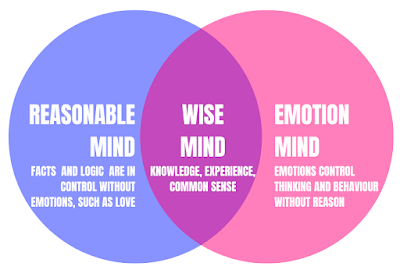
(BunnyPG, CC BY-SA 4.0 <https://creativecommons.org/licenses/by-sa/4.0>, via Wikimedia Commons )


Whereas emotional mind has you deeply in touch with your emotions, when you’re in that state, you’re not acting with any rationality. Likewise, when you’re in rational mind, you’re not taking emotions into account. This is how we get into overwork and burnout, and how we make decisions that railroad over the feelings and needs of others and of ourselves. Wise Mind combines the best of rational and emotional states. But you have to practice getting there. The best way to do that is to rest, to pause, to settle into the present moment, and to observe all the things that are ricocheting around you, internally and externally. 

(Wise Mind, by the way, is a term coined by Marsha Lineham, who developed a kind of therapy called DBT (Dialectical Behavioral Therapy) to treat people with major issues in relating to others. Guess where some of her ideas came from? Buddhism and mindfulness. Her therapy helps people learn social and interpersonal skills in conjunction with talk therapy.)

How do you get to Wise Mind? Practice, practice, practice. More specifically, you get to Wise Mind by taking a rest in the moment, pausing to observe what is going on with you. There’s the rest from accepting whatever situation in which you happen to find yourself. Are you in the above scenario? Why make it worse by getting even more agitated about being late? Why berate yourself or others? Why not take a moment, accept that this is what’s happening: you are rushing, it happens; next time, perhaps you can plan better, but maybe you are doing the best you can because maybe something came up, right as you were getting ready to leave. The point is, rest in the uncomfortable truth, and it alleviates some of the your discomfort. There’s the rest in not piling on guilt or a sense of shoulda-coulda-woulda to a difficult situation. 

There’s rest that means acceptance. This is the rest of letting-go. This rest means accepting what is happening when you can’t control it, for one thing. It also means accepting yourself, with all your foibles, is another. Are you the type to get your proverbial panties in a twist over stuff that doesn’t stress out most of the people you know? Don’t make yourself feel worse by should-ing yourself about not being so uptight. Just own it, you are uptight. This has its good and bad aspects, doesn’t it? Maybe all those laid-back others in your life depend on you to think of the details. So, accept that aspect of yourself. Radical self-acceptance, baby. If you remove the layer of non-acceptance of what is, you have a better chance of seeing clearly. Maybe there’s something a bit pathological about your need to control, but you’re not going to be able to change it without looking right at it. You’ve got to rest with it. Rest with it before you wrest with it. 

I couldn’t resist the pun.

Rest can be as accessible as a sigh. At any time, a deep breath provides an instant of rest. It’s not necessary to wait for a vacation to rest. What is necessary is to rest a little bit every day. As my final semester of graduate school ramps up, I plan to remember to rest more, so I can operate from Wise Mind and cope with the vicissitudes of AP2. Bring on the variants! 


Saturday, August 29, 2020

Recollecting Impermanence

Hello, Readers. Since last I wrote, the beloved pooch has died. This is terribly sad, and I notice his absence everywhere, for example when I wake up and no longer have to step over a large, sleeping dog. Or when I peel a carrot, and I realize he is not waiting patiently on the doormat for me to toss him the ends. It’s sad and we are all grieving, and yet it was inevitable that we would outlive him, barring unforseen circumstances.To avoid this situation, I would have had to adopt a tortoise, I suppose, but they’re not much good for midday walks. 


Impermanence has, therefore, been on my mind. The truth of impermanence is one of those truths to which we pay lip service. We know life is short, and that change is the only certainty in life, but we usually only know it theoretically, or intellectually, not in a bone-deep way. Yet knowing the deep truth of impermanence is key to appreciating what’s happening right now. Understanding impermanence is the doorway to wisdom, so they say. They, in this case, being Buddhist teachers. 

Buddhist philosophy feels impermanence is so important that everyone, layperson or monk, should contemplate it daily in the form of the five daily remembrances. They are as follows:

  1. Just like everybody, I am of the nature to experience illness. I cannot avoid sickness
  2. Just like everybody, I am of the nature to grow old. I cannot avoid aging. 
  3. Just like everybody, I am of the nature to die. I cannot escape death. 
  4. I am the owner of and heir to all my actions. 
  5. I must be separated and parted from all that is dear and beloved to me.
Those last two are listed in different order, depending on the translation.

—Upajjhatthana Sutta 


I’m not going to lie, these seem like a bummer. Number five is really hard to take, these days. I lost an earring down the bathroom sink the other day. I swear that thing committed harakiri, because otherwise there is no explanation. Unless it is that my ear holes have stretched and sagged along with everything else on my person? But I mean maybe the earring disappeared to get me to pay attention to the blog post I’ve delayed writing for days. Was this not karma showing me the truth of this contemplation? Really, it’s very sad, this truth. In the way I understand the practice, by facing this idea daily, I am to become less grasping after stasis and more accepting of the true nature of life, that it is transitory, from the briefest mental image or thought, from the strongest emotion to the longest life. Once I accept this, I suppose, I am free from a layer of sadness and anxiety about the inevitable changes, and this extra space allows me to appreciate what is before me more fully than I do when I am worried about something or someone slipping away. Earring. Dog. Daughters. Life. 

I may be a little tender on this reflection, considering the dog, considering that we’ve just dropped the younger daughter at college for the first time. The elder daughter will soon decamp from our comfortable pandemic bubble for a job in Boston. My sister the psychoanalyst is one year older today, which means I am, too. And none of your “she’s only one day older than she was yesterday” folderol. Sometimes the milestones hit you. 


Here’s a secret. I’ve found that when I contemplate these five remembrances, I feel a bit of relief. It’s just the teensiest bit of relief, more of a minute relaxation deep in my gut. I think it has to do with letting go of some of the struggle to collect and keep everyone and everything dear near. I think it has to do with releasing some shame around aging, illness, death, responsibility, and loss. I think there is shame around these things sometimes. We feel that if we experience them, it is our fault for not managing well enough in the world. We didn’t exercise enough, or eat the right food in the right amounts. We didn’t appreciate the gravity of our choices at the time and could have chosen better. Maybe you don’t feel that way, Readers. If so, I am glad for you. For me, I have found it so. Which means, that counterintuitive as it seems for me, these recollections do help me be more comfortable. 

I was informed that my earring, a thing I hold dear, was most likely retrievable from the trap under the bathroom sink. I marshaled my resources to figure that out—by which I mean I texted the husband, who said he would do it when he got home from work.

The husband did indeed find my earring. So what does that mean? It means that sometimes things from which we are separated come back to us. As Sting told us, back in the early 1980s, “If you love something, set it free, free, free.”

Sting’s lyric doesn’t exactly apply to losing an earring. It might apply, however, to letting your child leave for college, and your other no-longer-a-child child leave for a new phase of life as a college graduate working for peanuts and trying to make the world a bit better. By "letting your child" I don't suggest I have any choice in these things. The letting is internal.

However, because of the covid, the new college student will indeed be coming back to us. Her college is only allowing the first years one semester on campus. The rest of the academic year will be remote learning, so that the older students can have a semester there. Oy. Such is the ever-changing nature of things. 

Meanwhile, Readers, I started full time graduate school for social work this week. At the ripe old age of one thousand and ten, I am returning to school for a master’s degree, with a plan to become a therapist. I don’t know if this is wisdom or foolishness, embracing of life, or denial of time passing. Nevertheless, I go forward. I cannot escape illness, death, or aging. I cannot avoid responsibility for my choices or letting go of all I love. Okay. So be it. 

Friday, October 19, 2018

Nuanced Tips for Success

My hairstylist, let’s call her Donna because that’s what I called her last time*, just yesterday said, “Age gracefully.”
“Ok”, I said. “And how do you do that?”
And she said, “Don’t look in the mirror.”
And I said, “Man, just when I can finally afford some decent clothes you tell me I’m not allowed to look in the mirror?”

So we can see where things are headed with me: graceless aging.

On the way back from Donna’s, I stopped to pick up a couple of things I had altered. Since I’m not exactly standard size—and really, who is?—I often need legs and arms shortened. On clothes, I hasten to clarify. I’m not a criminal. In this case, I needed the torso shortened on a sleeveless blouse. This was a wrap blouse, which was finally ready, after a couple of weeks and one vain effort to pick it up the other day. N, the alterationist, is kind of busy these days. She has to hack her way to the front of her shop through a stand of wedding and bridesmaid dresses like she’s hacking her way through Spanish moss and vines in the Dismal Swamp.

Anyway, I took home my altered items only to discover that N had not only made the correct alteration on the armholes of the blouse, but had also made an additional alteration. She had sewed shut the slit in the side that allows the sash to wrap around the waist. Well, early blog readers might recall an altercation I had with a different tailor over a pair of improperly hemmed pants.

But I have since learned a few things, Readers. Namely, to inspect my altered items soon after picking them up, rather than after throwing away the receipt. Also, that life is really so much more than an accidentally sewed-up seam slit. Really, how big a deal is it? I mean, considering everything else that I’m not writing about on my blog.


Nary a seam slit.

So, I gave N a call. N of course said the slit was right there, in the seam. And I, holding the receiver to my ear, took another look at the garment. I ran my hands over every inch of it. I pushed my glasses up my nose to double-check. No seam slit. So I said, and I am giving myself credit where due, “N, I see where there was a slit, and I see that it has been sewn up by mistake, so I will have to bring it back to you so you can fix it.” And she said she would be there Saturday, and so did I.

Then the phone call ended. No gaskets blown. This is the thing for which I give myself credit: no blown gaskets. I mean, really, is it necessary? And would it be helpful in getting the proper seam slit in my blouse?

So, I don’t know, maybe some of my aging might be graceful, after all.

**
This reminds me of when I was bridesmaid in my friend’s wedding. Her life was all wedding plans and roses, and I was in therapy, loveless, and dissatisfied with my life. After every time I went with my friend to do something wedding-related, I bought myself a present. I was going broke, which I complained about to my therapist, since my job situation was part of my problem. To my great surprise, she did not make me feel like a spendthrift fool drowning my sorrows in retail therapy; she simply suggested that I buy myself less expensive presents. Instead of a new Benetton sweater—this wedding was a looooonnnnnng time ago—maybe a book or a lipstick.

I am not getting political here, but I am suggesting that my therapist once suggested to me that a little self-care in times of stress is not a bad thing. I say she suggested it, since she did not outright state this maxim. The psychotherapeutic relationship is not built on offering specific advice. You don’t pay for advice. You pay for nuance. Just remember that. Nuance is much more expensive than advice, by the way. However, studies show that we can tolerate and even incorporate nuance more easily than advice.

So, what have I suggested to you in this silly post? At least two, if not three pieces of advice. All free, let me add. What do you think they are?

Thursday, December 15, 2016

It Takes More Than a Dollar to Save a Dollar

So. I bought these new boots a couple of months ago. Just this week, I finally got around to buying some of that waterproofing spray for them. At the shoe establishment - a national chain - DSW - I found not one but two kinds of waterproofing spray. One can was large and fat and cost $5.99. One can was slender and shorter and cost $12.99.

 “What’s the difference?” I asked the cashier, who was both tall and slender, and he said, “That one’s better. It lasts longer.” 

Which one do you think he pointed out?  That’s right, the more expensive one. So I picked it up. Yes, I was about to buy it. But then something broke through in my brain. A little voice inside me doubted. A little voice inside me said, Hope, don't fall for the fake news. So I picked up the cheaper spray and read the label. No warning about reapplying frequently or anything like that. Just a cocktail of noxious chemicals. Just like the ones the more expensive bottle promised to spray into the air. 

Reader, I bought it. I bought the cheaper spray. There's lesson in there for all of us. Something along the lines of how much harder it is to save a dollar than to spend one. That’s because it takes more than a dollar to save a dollar. Unless you’re a kid who gets an allowance. But to earn enough money to save a dollar can take a lot of money. So don’t waste it. Something like that. 

In other news -
It’s hard, but I’m breaking my social media habit. Things got a bit too compulsive with me and Twitter over the last couple of weeks. I got into a thing with a couple of trolls. This led to a long conversation with a conservative man that caused me to spend a lot of time researching facts to combat his fake news take on things. In the end, the conversation was overtaking my brain, and while the arguing and the research were helpful to me because they forced me to express myself clearly - not to mention to read the news closely - ultimately, it was a waste of time. He went his way, I went mine. Nobody changes anybody's mind unless they're ready to change. And I decided I need to get off Twitter. 

One of things this guy said was that he read a couple of my blog pieces. After he read a couple of my blog posts, he said he recommended I call what I’m defining something other than success. According to him, I’m not talking about success as much as I’m talking about love or something else. He pointed me to some guy with some theory about levels of love. I ignored it, because he was being very unloving about immigrants and I was busy sending him links to Pew Research articles. 

I suppose this guy was trying to be helpful. I suppose he meant it as a nice gesture, but I couldn’t help thinking that this guy totally missed the point. If I call what I’m defining something other than success then I’m no longer redefining success. Now, he was a commercial real estate developer, which means - and I here stereotype freely - that he has that traditional, old-school, money+ power +prestige definition of success. You know, the one that was crushing me until I figured out a way to feel successful without those things. At least some of the time. But I do see what he means. 

I’ve certainly thought about the issue. Am I actually really talking about success, or am I talking about improving quality of life, or creating meaning or happiness? Well, I’m talking about all of those things. But I am also talking about success. As in, a feeling of accomplishment, a feeling of purposefulness, a methodology for pursuing goals and a system of living that contributes to all of those things. And here’s the thing. Even if I’m a canary in the coal mine of the dark and murky future, I know it’s more important than ever to sing my little song. 

So. Let’s tawk, Readers, about the key to success of having like-minded others who act as loving mirrors for you. I mentioned this in passing last week, when talking about Adam Grant and how he focuses on collaboration and other skills that lead to the greatest success. Collaboration is actually different than having loving mirrors. Collaboration means working together towards a common goal. Cultivating like-minded others means accepting help from others to help you reach your goal, and doing that for others in return. 

One thing that works quite often is establishing a regular gathering of these like-minded others. Entrepreneurs do this. Benjamin Franklin did this. Napoleon Hill recommended (men) start Mastermind groups. As I’ve mentioned, I have a monthly conference call with a couple of like-minded women. We have been meeting over the fiber optic cables for over five years now. Each of us has her individual goals, and we report on them to one another, offer each other support, suggestions, pep-talks, or ideas as needed. As you know, I’ve been through ups and downs. Well, we all have. 

Today, our conversation started out down. We were all down. But by the end, we were all up and inspired. My friend C (as in, Met Her in College), said, after a few minutes of rumination on current events, that we have to make sure we take care of ourselves and continue to work towards our goals. We cannot allow ourselves to become demoralized and immobilized. We have to strengthen ourselves so that we can come back strong. This was heartening and inspirational. 

But we are more than inspired. We are successful! Take E. She started out with an idea she wasn’t sure how she wanted to develop. Over the past five years, she tried writing a book, had an agent, lost the agent, gave up on the book, considered a podcast, felt discouraged, started a website, hosted a gathering based on her project, and from that gathering got the idea of a new way to work with her material. She’s turning it into a stage production with help from people she met at the gathering she hosted because of the idea she had five years ago. In between, there were times when she wanted to give up her project entirely, but we, her loving mirrors, convinced her it was important and worthwhile to pursue. And now she feels she has the right format for her idea, and she has a director and an actor and writer to help her bring it into production. 

That is the value of meeting with a group of like-minded others. They act as loving mirrors who reflect your possibilities back at you, give you courage when you lack it, and show you a better you. 


I call that inspiring.